Equity, Diversity and Inclusion member survey
Earlier this year, we shared a survey on Equity, Diversity and Inclusion (EDI) with our members. The survey intended to help us better understand our members’ perspectives on the topic, and the outcomes will inform the decisions we take regarding the direction of future EDI projects, such as the next iteration of our organisational EDI Plan, due in 2027.
Due to the content of the survey, most of the questions were open exclusively to professional membership grades, though all members were able to provide general feedback.
Who responded?
We received nearly 200 responses covering a range of demographics, specialisms and perspectives. We collect annual membership demographic data as part of our Annual Report, and as such can draw comparisons between our overall membership and the cross-section who chose to respond to this survey. This allows us to begin to consider why the perspectives of different groups may be over- or under-represented compared to their presence in our overall membership.
Below are some key points of comparison to our professional membership demographics:
- 56%* of EDI survey respondents were female, compared to 42% of our professional members.
- The ethnicity distribution of respondents was very similar to our overall membership.
- Most respondents were aged 35-54. This aligns with an average age of 43 for our subscribing members. This also means the largest proportion of respondents have likely worked in the environmental sciences for 11-20 years, with many also having been in the sector for 21-30 years.
- The vast majority of respondents live and work in the UK.
In addition to personal characteristics, we also asked respondents to indicate the sector(s) and specialism(s) they work in. These questions highlighted some deviations from our overall professional membership:
- Only 41% of survey respondents worked in consultancy versus 71% of our professional membership. This meant representation was up for public and civil; academia; and NGO/charity. Those working in industry made up a similar proportion of survey respondents to overall membership.
- The representation of different fields was broadly similar to our overall membership. However, there was underrepresentation from our largest fields: air quality; environmental management; and land condition. This meant that the following fields were overrepresented in the survey responses: education and training; heritage and archaeology; marine and coastal science; odour; and transport.
What do our members think of the IES' approach to EDI?
We asked members what EDI meant to them and received overwhelmingly positive responses. Key themes included representation; a positive outlook on differences; fairness; accessibility; education; and a positive workplace culture. There were a small amount of negative reflections on EDI, including some suggestions that it is distracting and divisive.
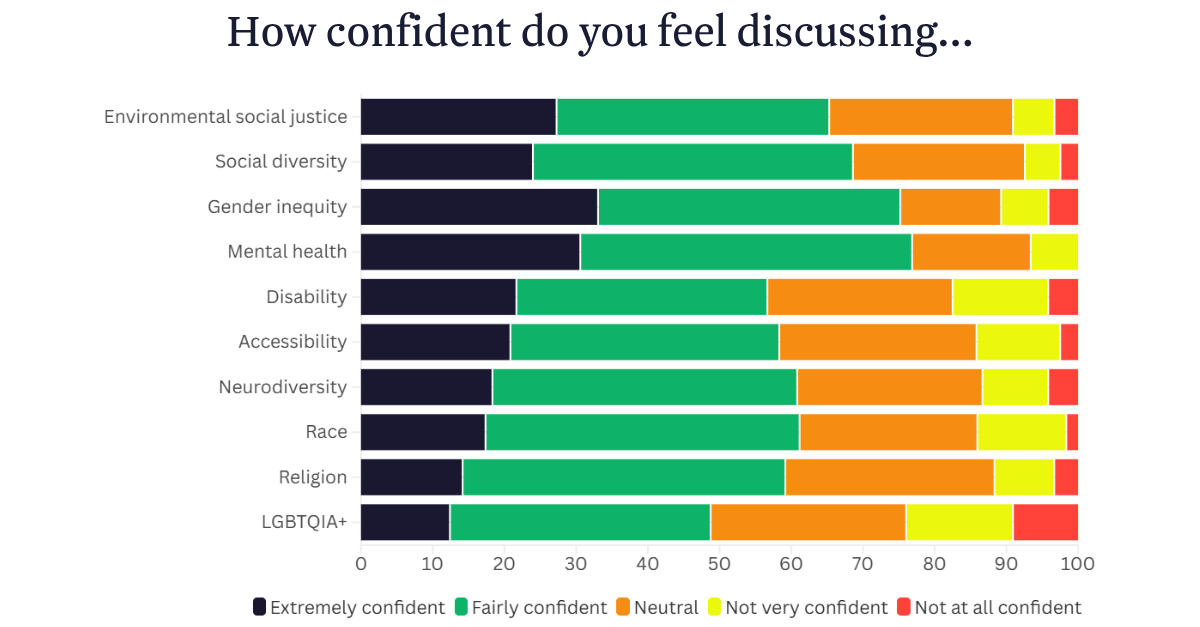
Our members are relatively confident discussing EDI in general, though confidence varies when discussing different facets of EDI. Over 75% of respondents felt fairly or extremely confident discussing mental health and gender. At the other end of the scale, just under 50% of members felt fairly or extremely confident discussing LGBTQIA+ issues. Topics such as environmental social justice, neurodiversity, race, religion, accessibility and disability fell between these points.
34% of respondents were aware we had an EDI Plan. Reflections on the plan included positivity about how comprehensive it was, and there was broad agreement that we should have one.
Criticism included a lack of information about progress towards different targets, with many respondents noting that they would like to be kept up to date with progress. There were also a large number of reflections on the accessibility of the plan, with respondents suggesting it is currently too dense and could benefit from a summarised version. It was also highlighted that we should promote the plan and our EDI work more.
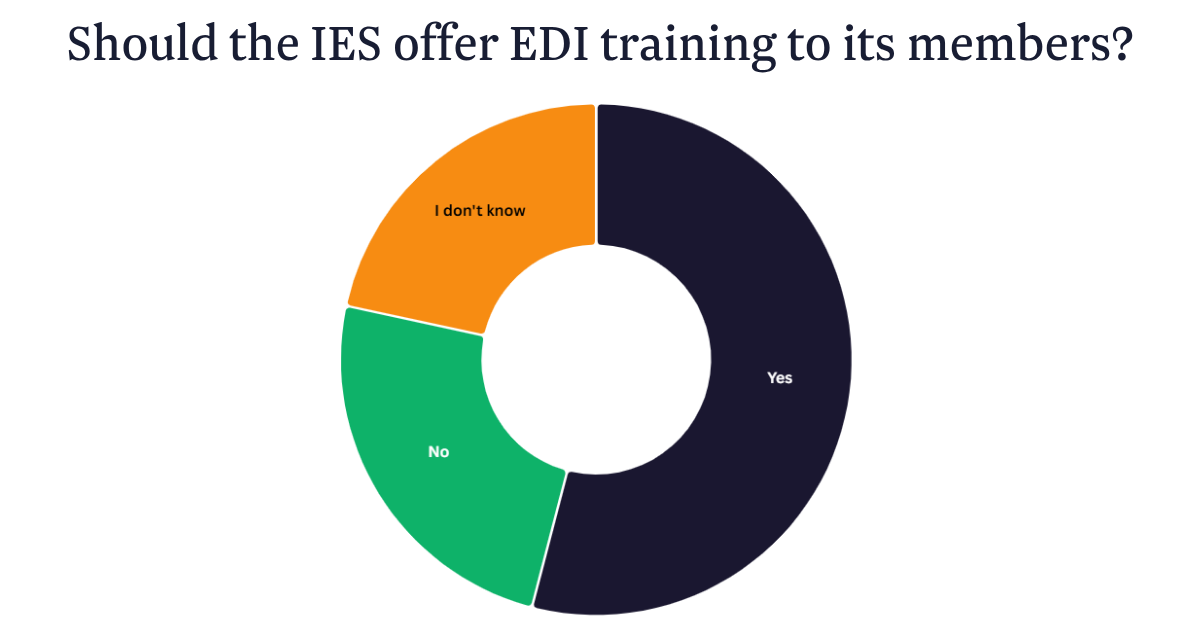
We received lots of great suggestions on what members would like to see us working on, either via our next EDI Plan or through other means. A few to highlight included: work around accessibility; supporting those with caring responsibilities; intersectionality; offering EDI training to members; and embedding EDI standards into professional standards and guidance. 54% of respondents believe the IES should provide EDI training, with the remainder of answers evenly split between “no” and “I don’t know”.
What are our members' experiences of EDI in the environmental science sector?
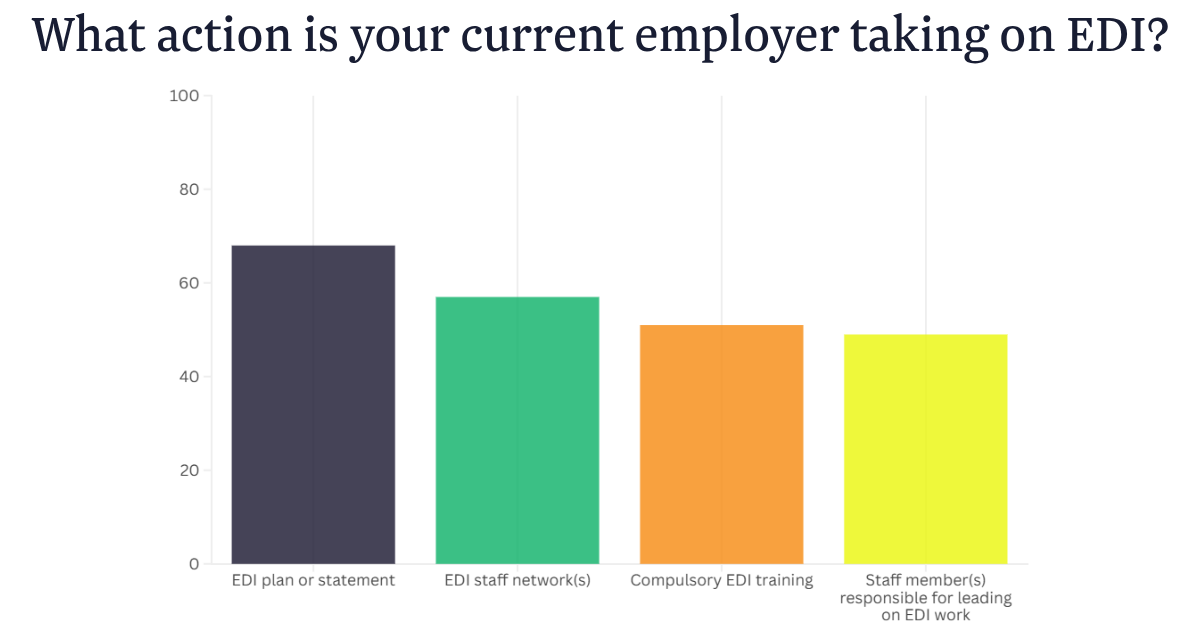
Based on survey responses, it appears concrete steps regarding EDI vary across the sector. The most common reported action was the presence of an EDI plan or statement, which was selected by 68% of respondents to this section. Staff networks, compulsory training and the presence of named staff members responsible for leading on EDI work fell between 49-57%. A few respondents noted that they were sole traders, but their experience ranged from being bound by the EDI requirements of their clients, to working in line with their own personal ethics, to feeling like they did not need to consider any specific EDI requirements.
Training also varies across the sector. The most common topic covered in training is race, but this was only selected by 32% of respondents as something that is offered by their employer. The remainder of topics listed were (in order of most to least common) gender; disability; mental health; LGBTQIA+; accessibility; neurodiversity; religion; social diversity, e.g. class; and environmental justice.
There were many examples of things that employers in the sector have done well with regards to EDI. Some interesting initiatives included: encouraging staff with lived experience of issues to directly contribute to policy redesign, e.g. staff networks with direct links to governance; and requirements for external contractors to adhere to EDI policies. There were also many examples of things that could be done better, including: relying on training and statements over action; not encouraging allyship; and confusing and inaccessible complaints processes internally.
About half of respondents felt that their careers had been directly impacted by issues relating to EDI. Being overlooked or cut off from progression opportunities was a common experience, with things like parental/caring responsibilities, gender, age, race and neurodiversity cited as reasons. Even without experiencing directly discriminatory behaviours, multiple respondents noted that they had ongoing doubts about whether decisions ‘behind the scenes’ were being made fairly, reflecting workplace cultures lacking in a real sense of inclusion.
We were moved to receive thanks from several anonymous members for providing an opportunity to reflect on EDI issues, along with plenty of comments on how important it is to continue this work. We would like to reiterate our own thanks to those who took the time to complete the survey.
What next?
We will be taking the survey outcomes into account as we move through the final year of our current EDI Plan, noting calls for increased transparency around progress and exploring how we can share the work we have done since 2023.
Later in the year, we will begin developing the next iteration of the Plan, which will cover 2027-30. We plan to provide updates on our progress at regular intervals once the Plan is published. We are also exploring replicating the EDI survey in future to continue capturing member feedback about our work and the wider sector.
We have already recruited a small group of EDI Champions, who will act as representatives of a range of member Communities and the IES Council. They will share their perspectives on our EDI work to ensure it captures the needs of members across the sector, and promote good practice within their respective Committees.
There is always more we can do, both internally and across the sector, and as such we are constantly looking for ways to improve our EDI practices, and welcome member feedback and ideas. If you would like to discuss anything in relation to this topic, please get in touch with Amy via communities@the-ies.org.
*All figures rounded to nearest whole number.
Banner image © layue via Adobe Stock