Speaking up for science: Case studies for environmental policy
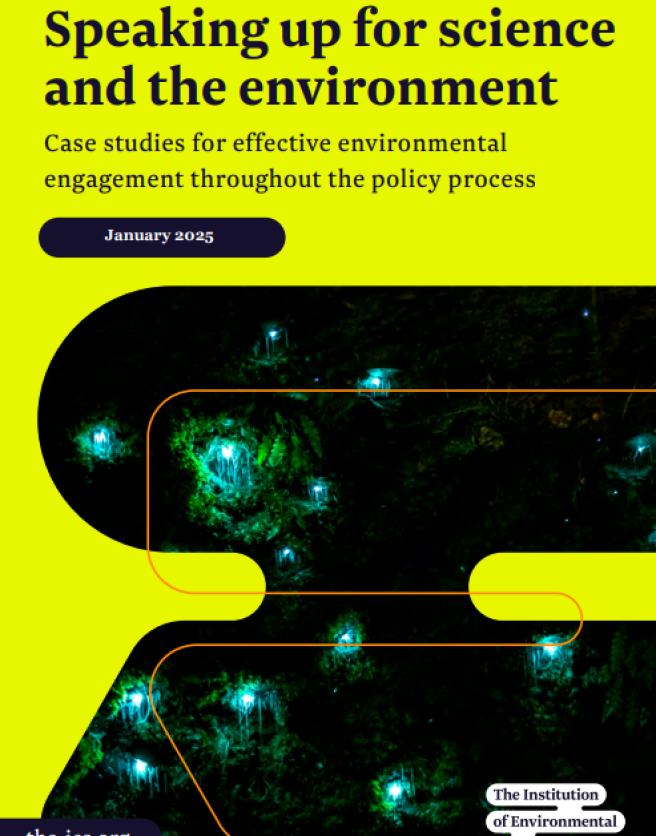
As a professional body, the IES understands that expertise is not an abstract concept: it is something that people have and that communities can share.
Case studies are a key part of sharing expertise. They support learning through clear examples of how a particular lesson was applied in practice, and they bring potentially intangible approaches to life.
Understanding how to effectively engage within the world of policy will be increasingly important for environmental professionals. This collection will take readers through the policy process, identifying how we can effectively engage with environmental policy at each stage.
From issue identification to implementation, it offers insights intended to spread good practice throughout the environmental policy community.
Our case studies include
- Setting the agenda: Soils and Stones - Sarah Ridgeon, Society for the Environment (SocEnv)
- Using evidence: Science and the BBNJ Agreement - Ed Hill and Alan Evans, National Oceanography Centre, UK
- Science-policy partnerships: Two case studies from a centre of expertise - ClimateXChange
- Policy and the public: Citizen science and air quality - Ruth Calderwood, City of London Corporation
- Uncertainty in policy: implications for climate change - Gary Kass, University of Surrey
- Impact and strategy: Strategic engagement and theory of change - Joseph Lewis, the Institution of Environmental Sciences
- Policy delivery: Lessons from the introduction of mandatory Biodiversity Net Gain - Ellie Savage, EPIC
- Policy implementation: The missed opportunity of Local Air Quality Management: A personal view - James Longhurst, Emeritus Professor Environmental Science, University of the West of England
- Policy evaluation: The 25 Year Environment Plan - Rebecca Wells, Logika Group
Overall, the collection provides a window into how environmental professionals are engaging with policy, from the early stages of emerging issues to long-term implementation and evaluation.



More ways to develop policy skills
- If you want more in-depth training in environmental policy, you might be interested in our policy training courses, Understanding Environmental Policy and Influencing and Engaging, which gives you an introduction to the policy landscape and how to influence it.
- You can also find a whole range of resources to increase your skills in policy on our dedicated policy skills and training page.
- If you want to stay up-to-date with the latest developments, make sure you are subscribed to Essential Environment.
- For more about environmental policy or the training we offer for members, please contact Joseph Lewis, Head of Policy (joseph@the-ies.org).
If you want to support the work of the IES to stand up for science and nature, become an affiliate, or if you’re an environmental professional, join the IES.
Header image credit: © Klanarong Chitmung | Adobe Stock