OEP Draft Strategy Consultation Response
The Office for Environmental Protection (OEP) is an Arms-Length Body responsible for protecting and improving the environment in England and Northern Ireland, which it achieves by holding to account public authorities and the Government.
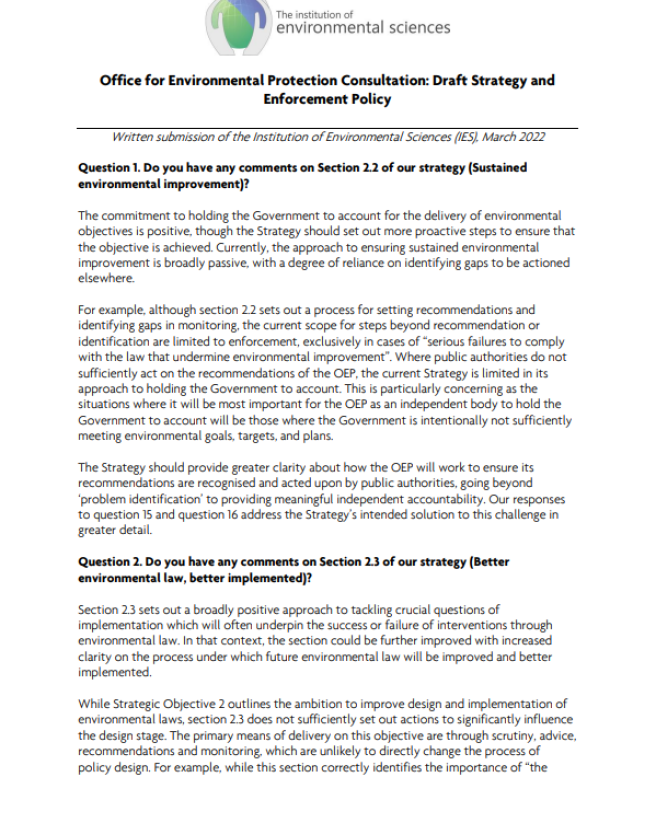
It was created by the Environment Act 2021 as part of the environmental governance arrangements which emerged from the UK’s exit from the European Union (EU). During the process of its creation, several workshops were held, in which the IES participated. Subsequently, a consultation was held on the organisation's inaugural strategy, to ensure it prioritised the right kind of actions to ensure oversight.
The IES responded to that consultation, emphasising the importance of an evidence-informed and systemic approach.
Key messages
- We had a broadly positive view of the OEP's draft strategy and plans.
- We (successfully) pushed for an ambitious approach that did not give up too early on holding the Government to account for all serious failures.
- We argued for oversight based on evidence and informed by a systemic perspective (which the OEP has since become very good at).
- We shared insights on the OEP's proposed approach to achieving an impact and how it could be strengthened.
- We called on the OEP to commit to an explicit process of reviewing the impact of its advice (which has more-or-less happened, though the Government's slow responses have created new concerns about effective scrutiny).
- We raised a specific concern about the OEP's principle of impartiality, which was fixed in the final strategy. The OEP cited the IES response while making the change.



Where to find out more
- If you want to stay up-to-date with the latest developments, make sure you are subscribed to Essential Environment.
- For more information about effective environmental governance in practice, read our report on reconnecting environmental targets with credible outcomes.
- Take a step towards developing your own policy skills through our training on ‘Understanding environmental policy’ and 'Influencing and Engaging with policy'.
- For local authorities working in air quality, see our Environmental Policy Implementation Community.
If you want to support the work of the IES, you can become an affiliate, or if you’re a professional in the environmental sector working with science, consider joining the IES.
Header image credit: © Vera Kuttelvaserova | Adobe Stock