
Why are environmental targets failing?
When we look ahead to the horizon, policy is one of the most reliable drivers of environmental outcomes. It charts a direction of travel and sets baseline requirements that drive change.
For policy to be effective, it needs a clear goal. Targets often play that role, giving us something to measure and a date that we hope to achieve it. In effect, they convert an aspiration into a tangible objective, around which we can build policy measures and hold leaders to account if they don’t meet the target.
And routinely we don’t meet our targets. We also don’t have effective accountability when that happens. Our targets are failing, and we need to know why if we want to achieve the aspirations they represent.
Flash back two years, to the old IES office in Shoreditch, when our President Julie Hill MBE gathered us to find out why targets weren’t working, and how we can reconnect them with the outcomes we need. That was the start of the project that has now produced our latest report: The Golden Thread of Governance.
Now we know why our environmental targets are failing. The next step is to fix them.
Joseph Lewis is Head of Policy at the Institution of Environmental Sciences, working to promote the use of the environmental sciences in decision making. Joseph leads the delivery of the IES Policy Programme, standing up for the voice of science, scientists, and the natural world in policy.
Joseph has more than ten years of experience in public policy, including in Parliament and the charity sector. He was recognised on the ENDS Power List 2026 as "a prominent advocate for ensuring environmental science is reflected in public policy".
Why do targets fail?
The full findings of the project are published in our report, The Golden Thread of Governance: Reconnecting environmental targets with credible outcomes. The most important analysis is knowing why targets fail to deliver outcomes, which requires us to understand how they can succeed.
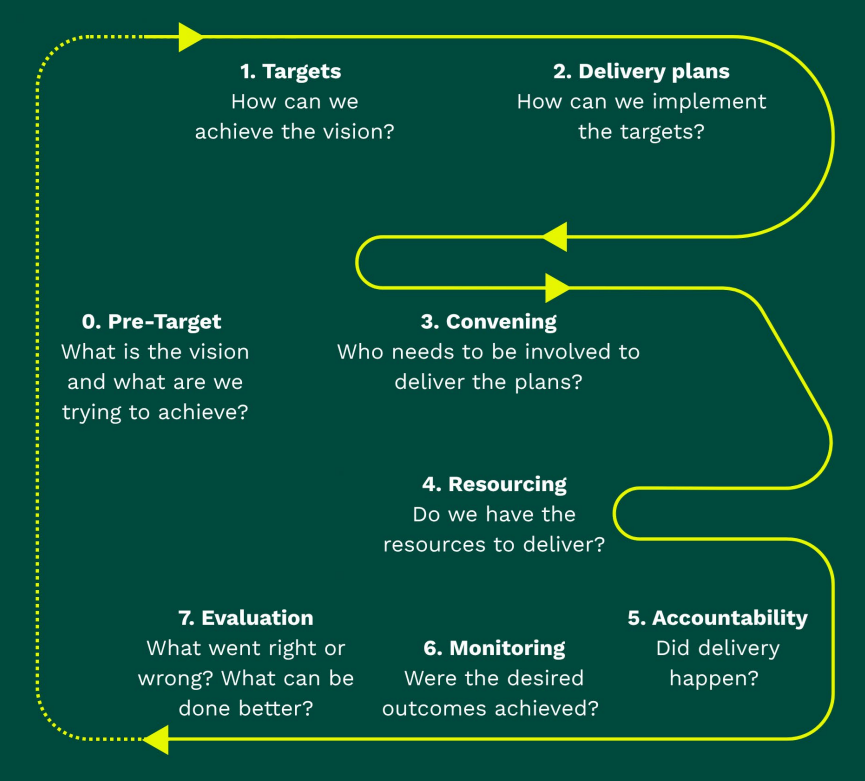
In search of an answer to the question of what successful targets look like, we produced an exemplar of The Golden Thread, which sets out seven (and a half!) key stages in the process of creating environmental targets:
- A unifying vision to underpin targets: Even before the process begins, leaders need to build a vision that sets out the goals the targets should be trying to achieve. Without a vision, targets often fail because they lack saliency, so they are quickly deprioritised or abandoned at the first sign of a trade-off.
- Clear, simple targets: When we make targets, they need to be clearly measurable as successful or failures, with simple and intuitive links to the objective they ought to represent. If targets aren’t clear and simple, they often fail when they become mired in complexity or when meeting them is so ambiguous that there can be no accountability.
- Actionable and specific delivery plans: After targets are set out, we need to deliver them, which means knowing who needs to deliver what, when and where they should do it, and how it can be achieved. Without delivery plans, targets often fail because the relevant people don’t know what they should do or aren’t accountable for making it happen.
- Convening for delivery: When we have a plan, we need to bring together the right people to realise it in practice. Targets often fail when key stakeholders across government, local government, delivery organisations or practitioners aren’t involved early, which means delivery plans don’t align with reality on the ground or don’t reach the people who need to support them.
- Resources for delivery: Plans also need sufficient resources, including time, money, and skills, if they are going to succeed. Targets often fail when they aren’t properly funded, leading to more costs in the long-term when plans need to be repeated.
- Strong accountability frameworks: Reaching outcomes requires some degree of accountability, so targets need to be backed by clear oversight, enforcement, incentives, and penalties that ensure the actions listed in delivery plans are realised. Without accountability, targets often fail as the drive to realise them becomes a lower priority than other tasks with more immediate consequences.
- Monitoring with a purpose: Monitoring can accomplish many goals, but it also comes with trade-offs between different outcomes. If we want targets to succeed, we need to make the right choices so that we can see whether the outcomes we wanted have actually happened. Without the right approach to monitoring, we often don’t know why targets are failing and can’t adapt to make them succeed.
- Evaluation and feedback to refine plans and delivery: Once we are informed by appropriate monitoring, we need to use the evidence we have in the right ways. Approaches like integrated assessments can help to make evidence actionable to decision makers. Without proper evaluation and feedback, targets often fail for the same reasons again and again.
Together, these seven and a half steps form the Golden Thread of Governance, and they show us how we can repair the link between environmental aspirations and credible outcomes on the ground.
Recommendations: How can we reconnect targets with credible outcomes?
Repairing the Golden Thread will require different actions in different places, yet there are seven recommendations that our evidence shows could improve the state of governance across all four countries of the UK:
- Start with clear, simple targets underpinned by a unifying vision
- Produce actionable and specific delivery plans
- Convene government, partners, and practitioners for delivery
- Provide sufficient resources to ensure delivery
- Use strong accountability frameworks at the programme or project level
- Monitor with a purpose and make better use of data
- Ensure monitoring and evaluation result in feedback to refine plans and delivery
To support adoption, the report contains more information about each recommendation, with evidence from two topics: biodiversity and the circular economy. It also includes case studies from across all four countries of the UK and more broadly, showing what works in practice so that we can learn from the past to make better choices in the future.
Read the full report for more information.
How have the experts responded?
At the launch of the Golden Thread, which took place at the Guildhall in London, Julie Hill MBE said “At the core of what all of us want are … these better outcomes. We have a good governance framework in the UK, but it’s not delivering what it needs to deliver, so how do we get those better outcomes?
it’s very clear it’s a loop; it’s a thread in a circle. There’s feedback involved and that’s very important. This whole business of setting targets is not a linear process. There must be feedback or the whole thing simply doesn’t work.”
Hill highlighted the collaborative nature of the project as one of its strengths: “What we needed was to get people together and have discussions. Collaboration is in the IES’s nature, we have a UK reach, we’ve had great collaborations with … all of those who’ve been involved in the workshops, interviews, in all of the discussions.”
Reflecting on those collaborations, Hill noted the importance of a systems perspective, to get a better picture of the system as a whole:
“Environmental problems are so wide ranging, the tendency is to work, and maybe sometimes to think, in siloes. Have we connected that to everything else? A systems perspective that understands that everything really is connected to everything else … just to have that perspective, that there’s a big world out there and it’s very connected and complex … we must think more broadly.”
Following the report launch, Denise Okpala, Member of IES Council and the Marine & Coastal Science Community Steering Group highlighted the importance of environmental targets that reflect the intersection between the environment and human health:
“Environmental targets must be viewed as preventative healthcare policies. Degradation of ecosystem services, whether through chemical runoff in water systems or habitat loss, directly drives long-term public health crises and escalates structural pressures on healthcare infrastructure.
… If targets are only bureaucratic, professionals will spend more time on administrative compliance than on driving the baseline ecological recovery required to protect planetary and human health.”
For more reactions to the report and its recommendations, watch the recording, including a panel discussion from Ruth Chambers (Green Alliance), Colin Church (IOM3), and Jill Rutter (Institute for Government).
What next?
The journey to the Golden Thread of Governance started two years ago, but it hasn’t ended yet. Informed recommendations are valuable, but only when we can use them to create real change. The next part of our work will focus on bringing the Golden Thread about in practice.
Over the coming months, the IES will be working to promote the Golden Thread as a solution to the challenges facing environmental governance, in partnership with our members, as well as stakeholders across government, the four countries of the UK, arms-length bodies, academia, and professionals.
If you want to help, please get in touch to share your perspective as we work together to reconnect targets with environmental outcomes on the journey towards a sustainable society.
Essential Environment: Latest analysis



Get involved
If you want to support the work of the IES to stand up for science and nature, become an affiliate, or if you’re an environmental professional, join the IES.
- Read more about how we can reconnect environmental targets with outcomes in the Golden Thread of Governance, or watch the launch event
- Join our Environmental Policy Implementation Community to connect with experts that are solving delivery problems in practice
- Sign up for our training course on ‘Understanding environmental policy’ and our new course on 'Influencing and Engaging with policy'
- Register for our interdisciplinary conference, Dialogue Between Disciplines, to connect with others helping to drive connections between disciplines
- Learn more about recent policy developments in our briefings on clean air, water policy and land and nature policy
- Find out more by reading the latest articles from Essential Environment, including insights on the latest climate risk report and our analysis on what the Land Use Framework means for environmental experts
If you want to learn more about environmental policy or the training we offer for members, please contact Joseph Lewis, Head of Policy (joseph@the-ies.org).
Header image credit: © H_Ko | AdobeStock