Between the peaks: closing the environmental delivery gap
As the UK’s Prime Minister comes to the end of his first 100 days, it’s time to take stock.
Since 2024, the environment has not been a priority issue for the Government and the new Prime Minister does not look like he intends to change that course. Despite some focus on water reform, climate adaptation, and the energy transition, the Prime Minister’s main interest in these is delivering public service and reducing the cost of living.
Holding out for optimism, there is still a big opportunity to shift course. If the Prime Minister did reprioritise the environment, it would do a lot to deliver on the new administration's objectives.
At the time of the election, we brought together hundreds of environmental scientists as part of a process to set out priorities for the environment over the next five years. Our work led to 11 recommendations, with more than 200 policy actions that could support the delivery of those priorities in practice, as well as clear notes on the potential benefits for the Government’s wider agenda.
Halfway through the parliamentary term, we have undertaken new research into each of those 200 actions, assessing how much progress the Government has made so far, and what still needs to happen to align public policy with the priorities of environmental experts.
Note: Our gap analysis was published in October 2026, ahead of the Budget. It only reflects the state of policy at that time, so it may not be a perfect reflection of every individual action, though as of this article being published, there has not been a significant change of course.
Joseph Lewis is Head of Policy at the Institution of Environmental Sciences, working to promote the use of the environmental sciences in decision making. Joseph leads the delivery of the IES Policy Programme, standing up for the voice of science, scientists, and the natural world in policy. He also delivers the IES policy training programme.
Joseph has more than ten years of experience in public policy, including in Parliament and the charity sector. He was recognised on the ENDS Power List 2026 as "a prominent advocate for ensuring environmental science is reflected in public policy".
What progress has been made over the last two years?
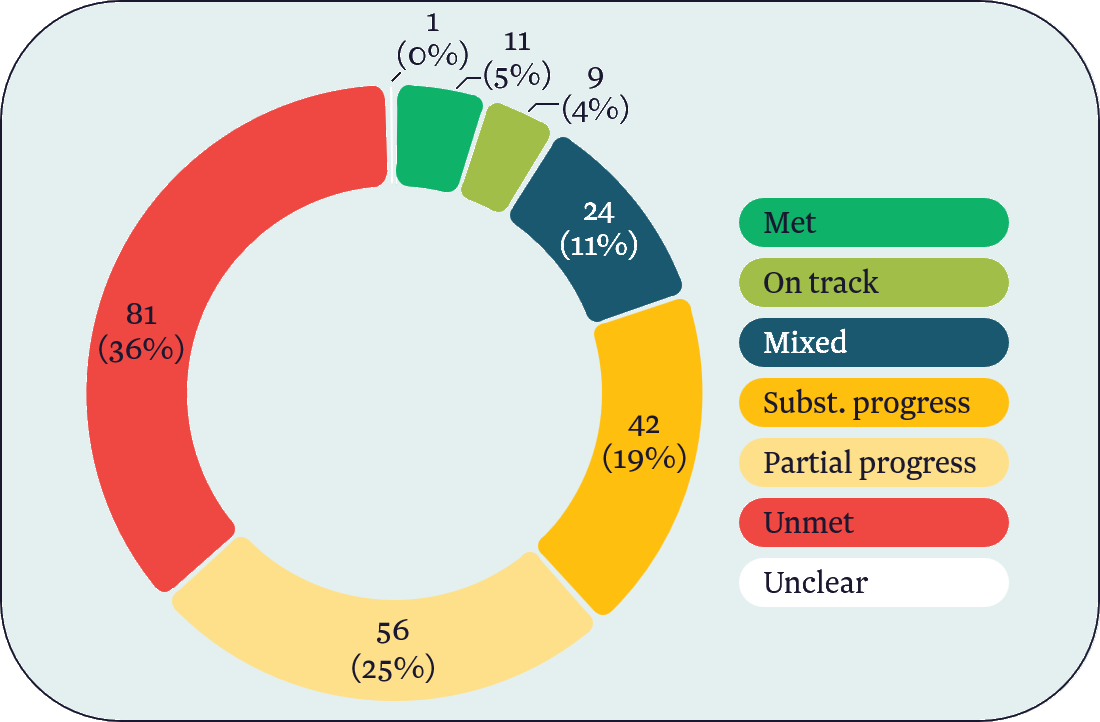
In short, the overall state of progress is poor. Just less than 10% of the delivery actions we outlined in 2024 have been met (or are on track to be met), while more than a third were evaluated as unmet.
For the actions between those extremes, there’s a divided picture. About 20% have seen substantial progress, and a quarter have seen meaningful but limited progress. There are also another 11% where action has been mixed, where positive progress in one or more areas isn’t being delivered across the board.
In many cases, that tends to be where the Government has taken action in the energy sector but not applied the same logic more widely to sectors like agriculture. As a result, the risk of unjust transitions and unfair impacts could be becoming more likely, with some parts of the economy left behind even as others make progress.
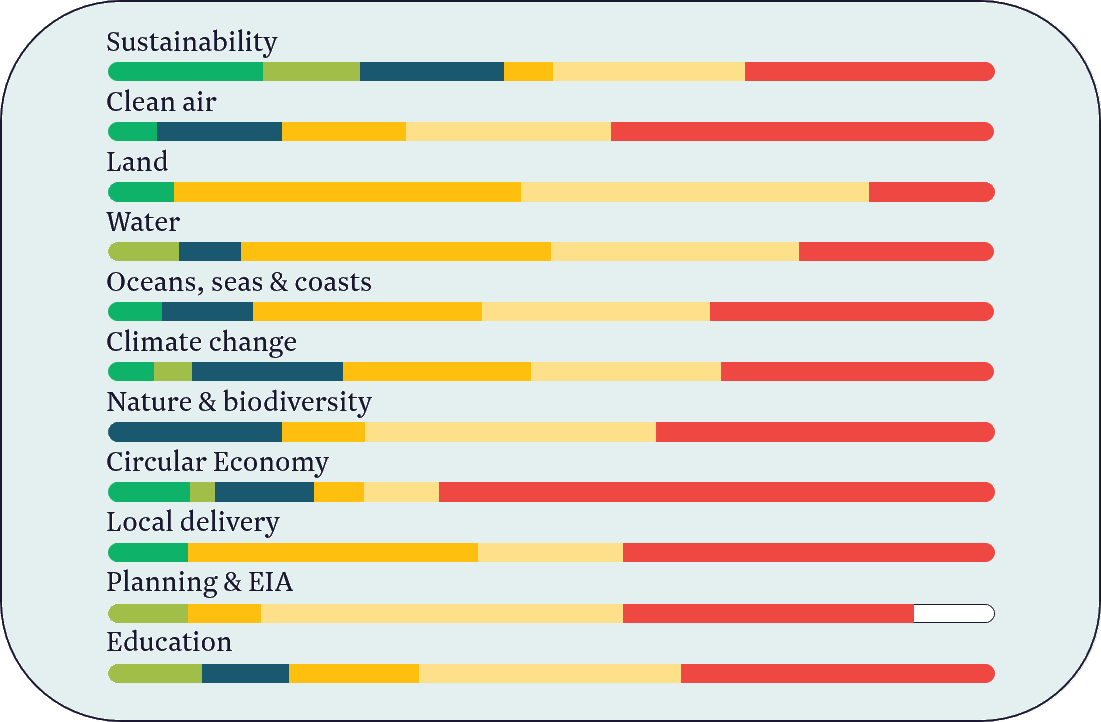
The general trend is the same across our 11 priority areas, but there are some topics where more progress is being made than others:
- Sustainability: While the Government has not delivered many of the systemic elements needed to support the sustainability transition, it has facilitated progress on governance and evidence-informed decision making, even if they haven’t led to transformative change beyond the energy sector.
- Clean air: Air quality is a mixed picture, with significant progress in many areas, but limited action in others, particularly at the local level where the shift towards health-based framing has not necessarily been met with sufficient practical support.
- Land use: While substantial progress has been made around the land use agenda, there’s been less progress on some land contamination issues and the supporting incentives and skills to drive action.
- Water: Many of the actions linked to water are still up in the air while we await either a transition plan for water or new legislation; promising signals have put some areas on track, while others are unlikely to be met without more action to support a strategic outcomes-based approach to water.
- Oceans, seas, & coasts: The UK has led some globally important action on oceans over the last two years, but there are still some major untapped areas needing more policy support, particularly around biodiversity and the blue economy.
- Climate change: There’s a very mixed picture around climate; the Government has taken the energy transition seriously and made lots of progress, but other priority areas like agriculture, adaptation, and nature-based approaches have had less substantial support.
- Nature & biodiversity: The Government has not yet changed the narrative on nature, and many policies are still unnecessarily trading off biodiversity, which has become a barrier to many of the actions we identified as steps towards a more strategic approach.
- Circular Economy: With significant delays to the Circular Economy Growth Plan, this is the area with the most unmet actions, yet substantial steps forward could come very quickly if the plan delivers on a strategic approach that tackles the most pressing sectors and challenges.
- Local authorities: Devolution is at the heart of the new Prime Minister’s agenda, and there are still quite big gaps to fill. While some new powers and opportunities are welcome, they don’t yet go far enough to empower local authorities to deliver for the environment, and there’s still a risk of backsliding due to resourcing issues and changes to planning.
- Planning & EIA: Planning reforms have delivered some of the strategic actions necessary to create a more proportionate and effective system, but the role of the environment in those reforms is mixed, and there are still uncertainties around Environmental Outcomes Reports and the potential for long-term strategic planning.
- Environmental education: Action on skills has helped to advance green skills, but it has not yet helped to reach the scale of green jobs growth that will be needed to support a sustainability transition. There are also gaps in the education system, where more support is needed to address funding challenges.
Read our full gap analysis for all the information, down to the details of where actions could be brought back on track.
Why does it matter?
As with all science, it’s important to make our caveats clear. These recommendations are the ones that IES members set as the highest priorities, rather than absolute measures of the state of the environment. While we linked them to government priorities in the report, they also aren’t a reflection of the state of progress towards existing government policy.
If you’re looking for an assessment of government policy progress, the OEP’s progress reports on environmental improvement are a good place to start, and for the state of progress towards the UK’s climate commitments, the Climate Change Committee’s reports on mitigation and adaptation have all the evidence.
So why should we care about progress towards the IES recommendations?
Firstly, the process to develop them is rooted in a robust and interdisciplinary evidence base. Across nine workshops, more than 300 environmental experts shared their views, representing voices from industry, research, government, NGOs, and the wider environment sector. The discussions included scientists, professionals, economists, farmers, and other experts across disciplines.
Drawing on their knowledge of what works and where action is most likely to lead to change, our recommendations and list of actions are based on the best available evidence. Collectively, they represent an evidence-informed approach to pursuing environmental outcomes and creating a country with thriving people, a healthy economy, and a flourishing environment.
Secondly, the recommendations reflect something even more important: coming from across specialisms and disciplines, they give us an insight into what transformative change for the environment could look like in the UK.
If we take every environmental issue in isolation, we’ll end up with many transitions, costing us more. A transformative approach would be faster, cheaper, and more effective at protecting people and the planet from the most devastating effects of climate change, biodiversity loss, and pollution.
That’s what these gaps mean in practice. Where the Government is lagging behind the recommendations, it means that we’re off track for transformative change: either the change won’t happen quickly enough, it will cost people more, or we will face worse impacts along the way.
What direction is the new Prime Minister taking?
Our gap analysis is not an evaluation of the new Prime Minister’s policy agenda. After only 100 days, there is not much that could already have been done to redirect the trajectory of government policy. This report is more an assessment of Andy Burnham’s inheritance: where is he starting from?
There are some early indications that give us an insight into what we can expect, and it looks like more of the same from an environmental perspective, without too many signs that an imminent shift is coming to put us back on track.
The Prime Minister’s conference speech, the latest planning reforms, and recent announcements on oil and gas all paint a similar picture: the existing environmental commitments of the Government will continue, but there is unlikely to be any renewed ambition.
It’s a shame, because Andy Burnham’s priorities line up very closely with what a transformative approach to the environment could deliver. Looking ahead to COP31 in the coming weeks, the call for fresh delivery on climate action will inevitably raise many question about how local areas can adapt and reduce emissions, putting communities at the heart of the climate debate.
For a Prime Minister who has had such success as a city region mayor, it could be a great opportunity to show how a Manchester-style approach could help the world address climate change.
There’s another opportunity around COP31. The Circular Economy has a place of importance on the conference agenda, falling within the days of the World Leaders’ Summit, when media interest is at its height. With so much hinging on the UK’s Circular Economy Growth Plan, COP31 would be a great chance to launch the plan, as long as it demonstrates an ambitious and systemic approach that could inspire other countries to follow suit.



Get involved
If you want to support the work of the IES to stand up for science and nature, become an affiliate, or if you’re an environmental professional, join the IES.
- Read more about the latest political shifts in our analysis on the recent conference season and what to expect from COP31.
- Join our Environmental Policy Implementation Community (EPIC) to support effective policy in practice, cutting past the politics to achieve outcomes.
- Sign up for our training course on ‘Understanding environmental policy’ or our intermediate course on 'Influencing and engaging with environmental policy'.
- Learn more about recent policy developments in our briefings on clean air, water policy and land and nature policy.
- Find out more by reading the latest articles from Essential Environment, including insights on how the Government talks about nature and our analysis on what water reforms could mean for environmental professionals.
If you want to learn more about environmental policy or the training we offer for members, please contact Joseph Lewis, Head of Policy (joseph@the-ies.org).
Header image credit: © hardyuno | AdobeStock